Summary
- Alphabet reported $63.350 billion in Google Search and other revenue for Q3 2026, while saying AI Mode monetization was lower than traditional Search.[4]
- Microsoft reported $6.554 billion in Search and advertising revenue for FY27 Q1, with ex-TAC revenue up 12%.[5][8]
- Meta disclosed more than 10 million Muse personal-agent setups, but did not report standalone search revenue.[1][6]
- Amazon said more than 400 million customers used Alexa for Shopping over the previous 12 months, while separately attributable assistant revenue was not published.[16]
- Apple said Siri handled more than 2.5 billion requests per day, but that figure does not establish AI-search usage or Siri AI revenue.[3]
Why it matters
Alphabet’s disclosures show the central business tension in AI search: usage can increase while monetization remains below that of established search formats. Alphabet said most AI Mode queries are incremental, but also said lower AI Mode monetization affected Search growth.[4]
Alphabet supplied the clearest AI-search disclosure in Q3 2026: Google Search and other revenue reached $63.350 billion, while management said AI Mode queries were growing but monetized below traditional Search.[1] Microsoft reported $6.554 billion in Search and advertising revenue for its fiscal Q1 2027, while Meta, Amazon and Apple disclosed developments in AI-assisted discovery, shopping and assistants rather than comparable standalone AI-search revenue.[2][1]
What happened
The September 2026 earnings cycle showed that AI search is moving into several different commercial models. Alphabet is adding AI Overviews and AI Mode to its core Search business, Microsoft is reporting advertising growth across Bing, Edge and LinkedIn, Amazon is embedding conversational product research into shopping, Meta is developing an AI shopping agent, and Apple is expanding Siri AI.[1]
The figures are not directly comparable. They use different periods, denominators and definitions, including quarterly revenue, annual customer reach, daily requests, agent setups and weekly-active usage.[2][3]
Why it matters
Alphabet’s disclosures show the central business tension in AI search: usage can increase while monetization remains below that of established search formats. Alphabet said most AI Mode queries are incremental, but also said lower AI Mode monetization affected Search growth.[4]
Microsoft’s results show that search advertising remains a material revenue category even when the company does not disclose a separate Copilot revenue line. Its fiscal Q1 2027 Search and advertising revenue was $6.554 billion, and revenue excluding traffic acquisition costs rose 12%.[5]
The other companies point to adjacent forms of discovery. Amazon reported more than 400 million customers using Alexa for Shopping during the previous 12 months, Meta reported more than 10 million Muse personal-agent setups in the United States and Canada, and Apple said Siri handled more than 2.5 billion requests per day.[3][6]
What we know—and what is not confirmed
Alphabet reported Search and other revenue, not a separate AI Overviews or AI Mode revenue figure.[4][7] Updated user totals for AI Overviews and AI Mode were not published in the cited earnings remarks, while Alphabet separately said the Gemini app had one billion users without defining that figure as monthly active users.[7]
Microsoft reported Search and advertising revenue and ex-TAC growth, but did not allocate revenue specifically to Copilot-generated searches or publish a standalone Bing user total in the cited FY27 Q1 materials.[1][8]
Meta did not report search-specific revenue, a combined Meta AI search audience or a standalone search-query total.[3] Amazon did not report separately attributable Alexa for Shopping revenue or a quarterly search-query total.[9] Apple did not report Siri AI revenue, web-search volume or an active-user total for the new Siri AI beta.[3]
Alphabet: Search Revenue Rose as AI Mode Monetization Lagged
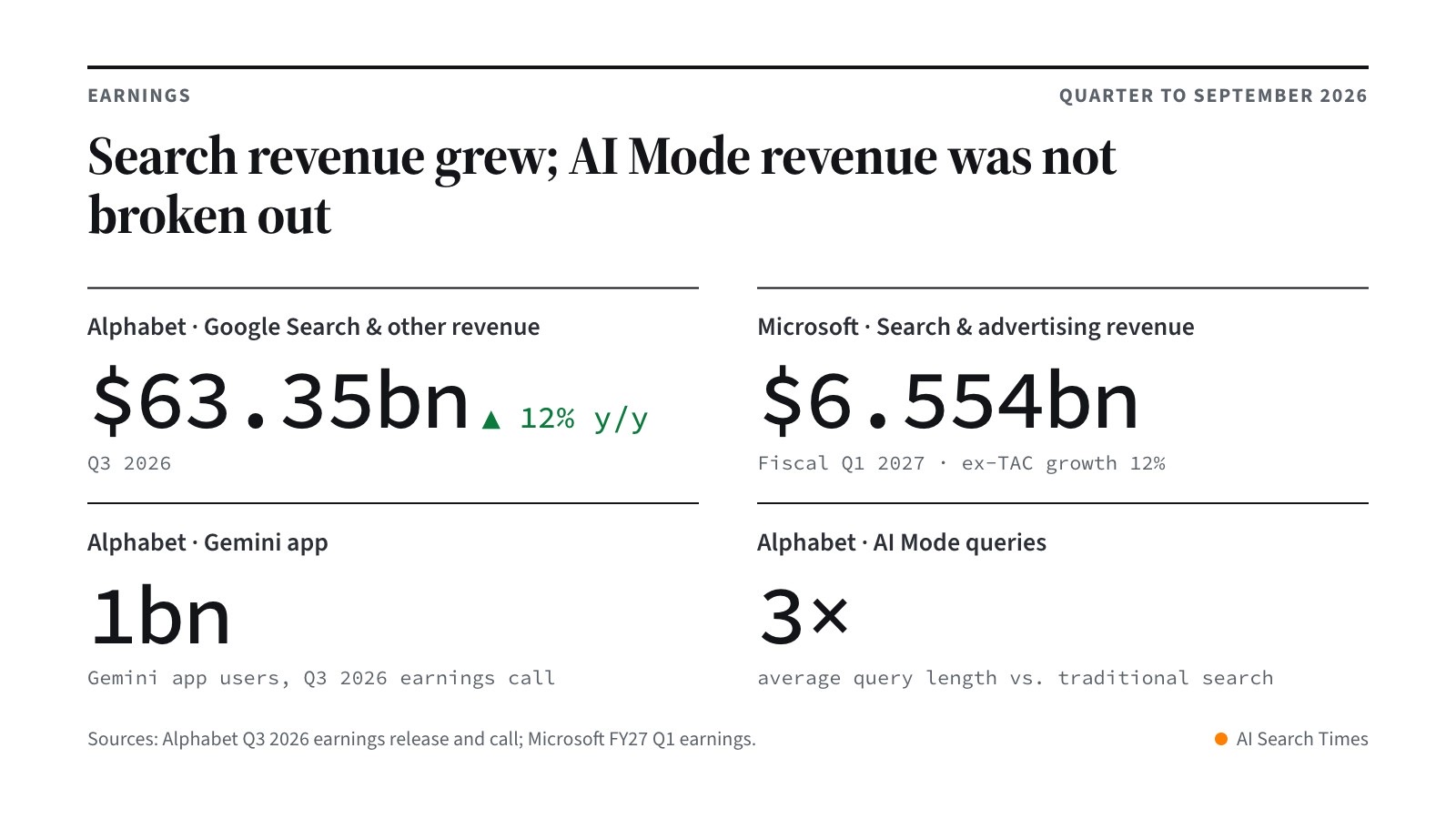
Alphabet reported its Q3 2026 results on October 28, 2026, for the quarter ended September 30, 2026.[10] Google Search and other revenue was $63.350 billion, up 12% year over year.[1][3]
| Company | Metric | Figure | Quarter |
|---|---|---|---|
| Alphabet | Google Search and other revenue | $63.350B | Q3 2026[4][7] |
| Alphabet | Search and other year-over-year growth | 12% | Q3 2026[4][7] |
| Alphabet | Gemini app users | 1 billion | Q3 2026 earnings call[4][7] |
| Alphabet | Average AI Mode query length | 3× traditional searches | Q3 2026 earnings call[4][7] |
| Alphabet | Multimodal AI Mode searches | 1 in 5 searches globally | Q3 2026 earnings call[4][7] |
Alphabet said AI Mode queries averaged three times the length of traditional searches.[4][7] One in five AI Mode searches globally used voice, images or documents, according to management’s remarks.[7][4]
The company also said overall query growth was at its highest rate in five years, although the cited statement did not provide a numerical growth percentage.[7][4] Google separately reported more than 50 billion visual searches per month, without identifying that figure as an AI Mode-only measure.[7]
AI Mode adoption and monetization
Alphabet Chief Business Officer Philipp Schindler said most AI Mode queries were incremental rather than replacing existing searches.[4] He also said click-through rates for sponsored and organic product-list items within AI Mode were already similar.[4]
At the same time, Alphabet said AI Mode monetized at a lower level than traditional Search and that this affected Search growth.[4] Management also identified foreign exchange as the largest driver of Search’s deceleration compared with Q2, alongside retail and media and entertainment dynamics.[4]
That makes AI Mode a disclosed contributor to the revenue discussion, not the sole explanation for the change in Search growth.[1]
Microsoft: Search Advertising Grew in Fiscal Q1 2027
Microsoft’s September 2026 quarter was fiscal Q1 2027, not fiscal Q1 2026. Microsoft reported the corresponding FY27 Q1 results on October 28, 2026, while FY26 Q1 covered the quarter ended September 30, 2025.[5]
| Company | Metric | Figure | Quarter |
|---|---|---|---|
| Microsoft | Search and advertising revenue | $6.554B | FY27 Q1[8][5] |
| Microsoft | Search and advertising revenue excluding TAC growth | 12% | FY27 Q1[8][5] |
| Microsoft | Comparable recast Search and advertising revenue | $5.942B | FY26 Q1 comparison[8][11] |
| Microsoft | Search and news advertising ex-TAC growth | 16% | FY26 Q1[8][11] |
| Microsoft | Consumer Copilot daily-user growth | Nearly 50% quarter over quarter | FY26 Q1[8][11] |
| Microsoft | LinkedIn members using AI-powered job search daily | 10M | FY27 Q1[8][5] |
Microsoft’s FY27 Q1 release reported $6.554 billion in Search and advertising revenue.[8] Revenue excluding traffic acquisition costs grew 12%, also in constant currency.[8][5]
Chief Financial Officer Amy Hood attributed the advertising growth to higher volume and rate across LinkedIn, Edge and Bing.[1] Chief Executive Officer Satya Nadella said Bing and Edge gained search share, but Microsoft did not provide a percentage share figure in the cited remarks.[11]
The results do not establish a Copilot revenue total. Microsoft’s reported category includes Search and advertising across named properties, and the company did not disclose how much came from Copilot-generated searches.[4]
The fiscal-year correction matters
The often-cited nearly 50% quarter-over-quarter increase in consumer Copilot daily users belongs to Microsoft’s FY26 Q1 call, covering the September 2025 quarter.[1] It should not be presented as a September 2026 result.
Microsoft’s FY27 Q1 call instead supplied a separate AI-search-related figure: 10 million LinkedIn members used AI-powered job search daily.[1] That is a LinkedIn job-search measure, not a Bing user count or consumer Copilot user count.[1]
Meta: AI Shopping and Discovery Without a Search-Revenue Line
Meta reported Q3 2026 results on October 21, 2026, for the quarter ended September 30, 2026.[12] Its materials discussed AI-driven advertising and discovery but did not separately report search revenue.[13][3]
| Company | Metric | Figure | Quarter |
|---|---|---|---|
| Meta | Muse personal-agent setups | More than 10M | Q3 2026[13][6] |
| Meta | Muse setup users active on a given day | About 25% | Q3 2026[13][6] |
| Meta | Muse shopping usage | More than 25% of weekly actives | Q3 2026[13][6] |
| Meta | Average purchase size discussed | More than $200 | Q3 2026[13][6] |
| Meta | Instagram search-result engagement improvement | 1% | Through Q3 2026[6][2] |
Meta said more than 10 million people in the United States and Canada had set up personal agents through Muse in approximately a month and a half.[6] About 25% of people who set one up used it on a given day, while shopping was used by more than 25% of weekly actives.[6]
These measures describe setups and usage shares, not a comparable monthly active-user total or search-query volume.[2][14]
Meta also said Instagram search-result engagement improved by 1% through the quarter’s end.[6][2] That is an engagement measure, not evidence of equivalent query-volume growth.[15]
Muse’s current business model
Meta described Muse as an agent that can compare options, answer questions and help complete purchases across websites and applications.[13] The company said Muse was currently monetized only through subscriptions, while transaction-based monetization would require greater scale, more users and more business connections.[13][6]
Meta separately discussed a Meta AI Business Assistant that helps advertisers search for creators and identify partnership-ad content.[6][2] That advertiser workflow is distinct from consumer search and from generative retrieval used to improve ad recommendations.[2]
Meta’s Q3 disclosures therefore show movement from feed-based discovery toward agent-assisted shopping, but they do not establish standalone AI-search revenue.[13][6]
Amazon: Shopping Assistance Reached More Than 400 Million Customers
Amazon reported its September-quarter results on October 29, 2026.[16][17] Its earnings materials referred to the product as Alexa for Shopping, while Amazon’s product documentation described the experience as bringing together Rufus and Alexa+ on the Amazon Shopping app and website.[18]
| Company | Metric | Figure | Quarter or period |
|---|---|---|---|
| Amazon | Customers using Alexa for Shopping | More than 400M | Previous 12 months[17][19] |
| Amazon | Customer interactions | Up 570% year over year | Q3 2026[20][16] |
| Amazon | U.S. spending per order among users | 50% higher than non-users | Q3 2026 discussion[9] |
| Amazon | Separately attributable assistant revenue | Not published | Q3 2026[20][16] |
Amazon said more than 400 million customers had used Alexa for Shopping during the previous 12 months.[19][16] Customer interactions rose 570% year over year, but Amazon did not identify those interactions as web-search queries.[19][20]
In a discussion of U.S. customers, Amazon said users spent 50% more per order than non-users.[20][1] That is an observed spending association, not a published conversion rate or proof that Alexa for Shopping caused the difference.[16]
Product research inside the purchase journey
Andy Jassy described Alexa for Shopping as a way to research products, compare options, review a full year of price history, receive personalized gift recommendations and track deals.[20] He said Amazon expected the assistant to become the primary agent customers use to shop Amazon.[20]
Amazon Ads said in June 2026 that sponsored ads could appear inside Alexa for Shopping conversations and that existing sponsored-ad campaigns were automatically eligible.[21] That establishes an advertising mechanism, not a Q3 figure for assistant-generated advertising revenue.[13]
Jassy also said external horizontal agents had not materially affected Amazon Ads, adding that few customers were shopping through them yet.[20] That was Amazon management’s assessment of its business, not an independent estimate of the broader market.[16]
Apple: Siri AI Launched, but Requests Are Not Search Revenue
Apple’s November 2, 2026 release covered fiscal Q4 2026, ended September 26, 2026.[9] The release highlighted the “all-new Siri AI,” while detailed assistant commentary came from the earnings call.[9][3]
| Company | Metric | Figure | Quarter or period |
|---|---|---|---|
| Apple | Siri AI initial availability | U.S. English beta | September 2026[9][3] |
| Apple | Additional Siri AI languages | French, Japanese, Korean, Portuguese and Spanish | October 2026[3] |
| Apple | Siri requests | More than 2.5B per day | Q4 FY2026 call[9][3] |
| Apple | Siri AI user total | Not published | Q4 FY2026 |
| Apple | Siri AI-specific revenue | Not published | Q4 FY2026 |
Apple said Siri AI launched in beta for U.S. English users in September and expanded to French, Japanese, Korean, Portuguese and Spanish in October.[3]
Apple also said Siri handled more than 2.5 billion requests each day.[3] The figure refers to Siri generally, not specifically to the new Siri AI beta, web searches or search-advertising queries.[3]
Management described Siri AI as understanding personal context, recognizing what is on screen and supporting natural conversation.[3] The company said the assistant was primarily request-based at that stage, while its orchestrator architecture could support broader capabilities over time.[3][1]
Apple discussed serving requests on devices and through Private Cloud Compute, as well as the effect of server-side inference on Services cost of sales.[3] It did not quantify a stable inference-cost mix or report a corresponding Siri AI revenue stream.[3]
What Does the Academic Evidence Say About AI-Search Quality?
Adoption and citation quality measure different things. A 2023 Findings of EMNLP study evaluated Bing Chat, NeevaAI, Perplexity and YouChat using citation recall and citation precision.[22]
| Study measure | Result | Meaning |
|---|---|---|
| Generated sentences fully supported by citations | 51.5% | Sentence-level support completeness[22][15] |
| Citations supporting their associated sentence | 74.5% | Citation-level accuracy[22][15] |
Citation recall measures whether generated statements receive adequate support, while citation precision measures whether a citation actually supports the associated statement.[15]
The study is historical evidence about the systems evaluated in 2023, not a benchmark of Alphabet’s, Microsoft’s, Meta’s, Amazon’s or Apple’s products in Q3 2026.[15] Its relevance here is conceptual: a product’s user growth or revenue does not establish the verifiability of its generated answers.[15]
How Should the Q3 2026 Figures Be Compared?
The earnings disclosures describe different parts of the AI-search economy.
- Alphabet disclosed the clearest usage-versus-monetization tension: AI Mode queries were longer and increasingly multimodal, but monetization remained lower than traditional Search.[4]
- Microsoft disclosed current advertising revenue and ex-TAC growth, but not a standalone Copilot revenue figure.[1]
- Meta disclosed agent setups, daily-use share and shopping activity, but not search revenue.[13]
- Amazon disclosed annual shopping-assistant reach and spending differences, but not separately attributable Alexa for Shopping revenue.[16][20]
- Apple disclosed assistant deployment and request volume, but not Siri AI revenue or search volume.[3]
The figures should therefore be read as separate indicators rather than combined into a single AI-search market total. Quarterly revenue, annual customers, daily requests, agent setups and weekly-active shares do not share the same denominator.[1][3]
The clearest conclusion is that AI search is being commercialized through several routes: advertising inside search interfaces, conversational shopping, agent subscriptions, product discovery and assistant ecosystems.[6] The Q3 2026 disclosures do not yet provide a consistent company-by-company measure of standalone AI-search revenue.[1]
Timeline: Key AI-Search and Assistant Disclosures
| Date | Company | Disclosure |
|---|---|---|
| June 2026 | Amazon | Sponsored ads became eligible to appear in Alexa for Shopping conversations.[21] |
| September 26, 2026 | Apple | Fiscal Q4 2026 ended; Siri AI was available in U.S. English beta during September.[3] |
| October 21, 2026 | Meta | Meta reported Q3 results and disclosed Muse setup, usage and shopping figures.[6][2] |
| October 28, 2026 | Alphabet | Alphabet reported $63.350 billion in Google Search and other revenue for Q3 2026.[4][10] |
| October 28, 2026 | Microsoft | Microsoft reported FY27 Q1 Search and advertising revenue of $6.554 billion.[5] |
| October 29, 2026 | Amazon | Amazon reported more than 400 million Alexa for Shopping customers over the previous 12 months.[16] |
| November 2, 2026 | Apple | Apple released its fiscal Q4 2026 results and highlighted the all-new Siri AI.[9] |
| November 17, 2026 | Research cutoff | The earnings roundup’s research cutoff was November 17, 2026. |
Background: why the denominators cannot be combined
A quarterly revenue figure measures money recognized during a reporting period, while annual customer reach measures people who used a product over a longer interval.[4][6] Daily request volume counts interactions, not necessarily distinct users or search queries.[1]
Agent setups count people who configured an experience, while a percentage of weekly actives describes behavior among a particular active-user group.[6][2] These measures can all indicate product adoption, but none can be converted into another without additional company data.[3][13]
The same caution applies to AI-search revenue. Alphabet reports a broad Search and other category, Microsoft reports Search and advertising across several properties, and the other companies do not publish equivalent standalone AI-search lines in the cited materials.[11]
Frequently asked questions
Did Alphabet report AI Overviews or AI Mode revenue in Q3 2026?
No separate AI Overviews or AI Mode revenue figure was published in the cited Q3 2026 earnings materials.[4] Alphabet reported $63.350 billion in Google Search and other revenue and discussed lower AI Mode monetization within that broader Search business.[4]
How much did Microsoft Search and advertising revenue grow?
Microsoft reported $6.554 billion in Search and advertising revenue for FY27 Q1, the quarter ended September 30, 2026.[5] Revenue excluding traffic acquisition costs increased 12%, but Microsoft did not allocate that result specifically to Copilot.[5]
Did Microsoft report Copilot users in the September 2026 quarter?
The cited FY27 Q1 materials did not publish an updated consumer Copilot user total.[5] The nearly 50% quarter-over-quarter growth figure for consumer Copilot daily users came from FY26 Q1, covering September 2025.[1][14]
How many people used Amazon Alexa for Shopping?
Amazon said more than 400 million customers used Alexa for Shopping during the previous 12 months.[19][16] That is an annual customer-reach figure, not a Q3 monthly active-user total or a search-query count.[2][13]
Did Apple’s 2.5 billion Siri requests represent AI-search usage?
No. Apple’s figure covered Siri requests generally and did not identify them as web searches or Siri AI-only requests.[3] Apple did not publish a separate Siri AI user total, search volume or Siri AI revenue figure in the cited materials.[3]
Sources
- 1Microsoft Fiscal Year 2027 First Quarter Earnings Conference Call — microsoft.com
- 2META Q3 2026 Earnings Call Transcript — s21.q4cdn.com
- 3Apple (AAPL) Q4 2026 Earnings Call Transcript & Audio — stockanalysis.com
- 4Alphabet Investor Relations - 2026 Q3 Earnings Call — abc.xyz
- 5FY27 Q1 - Press Releases - Investor Relations - Microsoft — microsoft.com
- 6META Q3 2026 Prepared Remarks — s21.q4cdn.com
- 7Q3 2026 earnings call: Remarks from our CEO — blog.google
- 8FY27 Q1 - Metrics - Investor Relations - Microsoft — microsoft.com
- 9Apple reports fourth quarter results - Apple — apple.com
- 10sec.gov — sec.gov
- 11FY26 Q1 - Press Releases - Investor Relations - Microsoft — microsoft.com
- 12Meta - Meta Reports Third Quarter 2026 Results — investor.atmeta.com
- 13META Q3 2026 Follow Up Call Transcript — s21.q4cdn.com
- 14Microsoft Fiscal Year 2026 First Quarter Earnings Conference Call — microsoft.com
- 15citations. However, not all generated statements are — aclanthology.org
- 16AMZN-2026.09.30-EX99.1 — ir.aboutamazon.com
- 17Q3 Earnings: Andy Jassy on Amazon Stores growth — aboutamazon.com
- 18Alexa for Shopping: Amazon's AI assistant for personalized shopping — aboutamazon.com
- 19Amazon.com, Inc. - Amazon.com Announces Third Quarter Results — ir.aboutamazon.com
- 20Amazon (AMZN) Q3 2026 Earnings Call Transcript & Audio — stockanalysis.com
- 21What agentic shopping means for advertising | Amazon Ads — advertising.amazon.com
- 22Evaluating Verifiability in Generative Search Engines - ACL Anthology — aclanthology.org
This report was compiled from the primary sources listed above. Read our editorial standards. To report an error, write to editorial@aisearchtimes.com.