
Summary
- OpenAI lists ChatGPT Ads Manager availability in 89 countries and territories, but the advertiser’s legal entity and billing location must be eligible.[5]
- Advertisers can buy through Ads Manager, existing agency or technology partners, and Aleph’s local sales operation in 44 markets.[3]
- ChatGPT Ads currently include response-ad placements with text and image assets, while image-generation advertising remains a separately announced U.S. test.
- OpenAI recommends a $3–$5 starting maximum CPC bid, but it has not published a universal CPM, CPC, CPA or minimum spend.[11]
- Early results range from positive directional case studies to mixed third-party evidence, so CPC, CPA and revenue figures should be reported with their original methods and benchmarks.[11]
Why it matters
ChatGPT Ads are no longer only a limited pilot with one buying path. The combination of Ads Manager, partner access and local reseller support gives advertisers several ways to enter the platform, while the 89-country availability list provides a clearer boundary for legal-entity eligibility.[3][6]
As of 17 November 2026, advertisers can buy ChatGPT ads through OpenAI’s self-service Ads Manager, existing agency and technology partners, or Aleph’s local sales operation in 44 markets. ChatGPT Ads are available across 89 advertiser-eligible countries and territories, but audience availability, advertiser registration and local reseller coverage are separate issues.[1]
What happened?
OpenAI expanded ChatGPT Ads to 89 countries on 21 October 2026 and said more than 100,000 advertisers had used the platform.[2] The company subsequently announced a local contracting and billing arrangement with Aleph across 44 markets, adding local-currency payments, payment terms, onboarding, campaign support and training.[3]
The Aleph announcement did not add 44 new audience markets. It created a local sales route for advertisers in those markets, while the countries and territories where ads can be shown remain governed by OpenAI’s availability rules.[1]
OpenAI currently offers three practical buying routes:
| Route | Who can use it | What it provides |
|---|---|---|
| Ads Manager | Businesses whose advertising and billing legal entity is in an eligible country or territory | Self-service campaign creation, budgets, bids, pacing, creative uploads and performance reporting.[4] |
| Agency and technology partners | Advertisers using OpenAI’s partner ecosystem | Campaign buying and support through existing partners in eligible markets.[3][4] |
| Aleph local sales | Advertisers and agencies based in 44 announced markets | Local contracting, invoicing, currency support, payment terms, onboarding and campaign assistance.[3] |
Which countries can use ChatGPT Ads Manager?
OpenAI’s Ads Manager availability page lists 89 countries and territories: Algeria, Argentina, Australia, Austria, Azerbaijan, Bahrain, Bangladesh, Belgium, Bolivia, Brazil, Bulgaria, Cambodia, Canada, Chile, Colombia, Costa Rica, Croatia, Cyprus, Czech Republic, Denmark, Dominican Republic, Ecuador, Egypt, El Salvador, Estonia, Finland, France, Germany, Greece, Guatemala, Hungary, Iceland, India, Indonesia, Iraq, Ireland, Israel, Italy, Japan, Jordan, Kazakhstan, Kenya, Korea, Kuwait, Latvia, Lebanon, Liechtenstein, Lithuania, Luxembourg, Malaysia, Malta, Mexico, Morocco, Netherlands, New Zealand, Nigeria, Norway, Oman, Pakistan, Panama, Paraguay, Peru, Philippines, Poland, Portugal, Puerto Rico, Qatar, Romania, Saudi Arabia, Serbia, Singapore, Slovakia, Slovenia, South Africa, Spain, Sri Lanka, Sweden, Switzerland, Taiwan, Thailand, Tunisia, Turkey, Ukraine, United Arab Emirates, United Kingdom, United States, Uruguay, Uzbekistan and Vietnam.[5]
The advertiser’s legal entity and billing location must be in a listed country. An advertiser therefore cannot assume that being able to reach users in a market also means it can register for self-service Ads Manager there.[4]
Which countries have Aleph local sales coverage?
Aleph’s 44 announced markets are:
| Region | Markets |
|---|---|
| Latin America | Argentina, Bolivia, Chile, Colombia, Costa Rica, Dominican Republic, Ecuador, El Salvador, Guatemala, Panama, Paraguay, Peru, Puerto Rico and Uruguay.[3] |
| Europe and Central Asia | Azerbaijan, Bulgaria, Croatia, Cyprus, Czechia, Estonia, Hungary, Kazakhstan, Latvia, Lithuania, Romania, Serbia, Slovakia, Slovenia, Ukraine and Uzbekistan.[3] |
| Middle East and Africa | Egypt, Kenya, Kuwait, Morocco, Nigeria, Qatar, Saudi Arabia, South Africa, Turkey and the United Arab Emirates.[3] |
| Asia-Pacific | Bangladesh, Cambodia, Hong Kong and Sri Lanka.[3] |
OpenAI says ChatGPT Ads are not available in-market in Hong Kong or mainland China, although businesses based in those locations may use authorized partners to advertise in other available markets.[3]
Why it matters
ChatGPT Ads are no longer only a limited pilot with one buying path. The combination of Ads Manager, partner access and local reseller support gives advertisers several ways to enter the platform, while the 89-country availability list provides a clearer boundary for legal-entity eligibility.[3][6]
The buying model also differs from Google’s AI-search rollout. Google says existing Search, Shopping and Performance Max campaigns can serve in AI Overviews and AI Mode without separate campaigns or budgets.[1] OpenAI instead presents ChatGPT Ads through a dedicated Ads Manager and partner ecosystem.[4]
This distinction matters for international planning. A marketing team must check three separate questions:
- Can ChatGPT Ads be shown to users in the intended market?[7]
- Is the advertiser’s legal entity eligible for Ads Manager registration?[5]
- Is a local contract, invoice or reseller relationship available?[3]
The answers may not be identical.
What ad formats are available?
The standard documented ChatGPT ad appears below a response. It can include the advertiser name, favicon, headline, description, destination page and an image asset.[8]
OpenAI says ad selection may consider the current conversation, the ad’s own content and, where personalization is enabled, selected signals from a user’s broader ChatGPT experience.[8][6] Advertiser-provided context hints can guide matching, but OpenAI says they are not exact-match keywords and do not guarantee delivery in a particular conversation.[8]
Ads are shown to users on Free and Go plans. OpenAI says Plus, Pro and Enterprise remain ad-free, while its Help Center also excludes Business plans and accounts identified as belonging to users under 18.[8]
OpenAI has also announced a separate visual-ad test during image generation. The initial test was described as being for Free and Go users in the United States with a first group of advertisers; the ad would be labeled and kept separate from the generated image.[9] This is a test announcement, not evidence that the format is universally available or that it has produced measured advertiser results.[10]
OpenAI says advertising does not influence ChatGPT’s answers and that advertisers receive aggregated campaign-performance information rather than access to individual conversations.[4]
How does ChatGPT Ads pricing work?
ChatGPT Ads supports reach, clicks and conversion-oriented buying options, but OpenAI has not published a standard platform-wide rate card.[8]
| Objective or strategy | How it works | November 2026 qualification |
|---|---|---|
| Reach | Optimizes for impressions and charges on a cost-per-thousand-impressions basis.[4][8] | CPM buying formed part of the initial pilot; no representative public CPM is provided in the cited OpenAI material.[11] |
| Clicks | Optimizes for valid clicks. | OpenAI recommends starting with a maximum CPC bid of $3–$5, but this is guidance rather than a guaranteed charge or average market price.[11] |
| Target CPA | Sets an average-cost goal for conversion campaigns.[12] | New campaigns began moving toward this strategy on 9 November 2026; actual average costs may be above or below the target.[12] |
| Target CPC | Sets an average-cost goal for click campaigns.[12] | The target is not a fixed price or guaranteed maximum.[12] |
OpenAI says the winning auction determines the charged price. The company also said the older Max Bid and Max CPC fields were scheduled to retire on 1 January 2027.[12]
The cited OpenAI pricing material does not publish a minimum spend, standard CPM, representative platform-wide CPC or representative platform-wide CPA.[11]
What does early CPC evidence show?
One Brafton campaign spent $1,524.11 between 17 June and 28 August, generating 46,024 impressions and 263 clicks. Brafton reported a 0.57% click-through rate, $5.80 average CPC, one attributed conversion, a 0.38% conversion rate and $1,524.11 cost per conversion.[13]
That result is a single campaign outcome, not a ChatGPT-wide CPC benchmark. Brafton said the campaign was too small to support broad conclusions and noted that objective, creative, targeting and landing-page quality can affect performance.[13]
How is ChatGPT Ads performance measured?
OpenAI’s measurement materials describe Pixel and Conversions API signals for purchases, leads, installs and sign-ups. They also describe click-through attribution windows and a one-day view-through window.[14]
OpenAI says incrementality measurement remains early. Haus, Measured and WorkMagic have been exploring geo-based experiments, while Kantar and Cint have been testing brand-resonance measurement.[15]
The main published measurement approaches include:
- Click attribution: connects a conversion with an ad click within the applicable attribution window.[14][15]
- View-through attribution: includes a one-day window for users who saw an ad but did not click it.[15]
- Conversion signals: uses Pixel and Conversions API data for purchases, leads, installs and sign-ups.[15]
- Geo-based experiments: compares exposed and control geographies to estimate incremental effects.[15]
- Brand measurement: evaluates brand resonance through external measurement partners.[15]
Advertisers should therefore distinguish between attributed conversions, observed revenue, blended CPA comparisons and causal incrementality. Those measures answer different questions and should not be treated as interchangeable.[7]
What early advertisers report
Early results are mixed and use different benchmarks, attribution windows and study designs.
| Advertiser or evidence source | Reported result | What the result does—and does not—show |
|---|---|---|
| Evernote | OpenAI reported 10%–20% higher trial-to-paid conversion than Evernote’s historical average across paid-acquisition channels. About 25% of desktop visits from the campaigns resulted in a new Evernote account.[16] | Evernote used web analytics and subscription records. The case study calls the findings directional and says they do not establish incremental lift.[16] |
| WeightWatchers | DV Rockerbox measured attributed CPA on ChatGPT Ads at 15.3% below WeightWatchers’ blended paid-search benchmark.[15] | This is an attributed CPA comparison, not a causal lift experiment.[15] |
| Dose | WorkMagic’s geo-lift study estimated 2.3 times more incremental orders than last-click attribution captured.[15] | OpenAI describes its incrementality work as early-stage, making this a partner estimate rather than a platform-wide result.[15] |
| Brafton | The campaign reported $5.80 average CPC, 0.57% CTR and one attributed conversion from $1,524.11 in spend.[13] | Brafton described the campaign as too small for broad conclusions.[13] |
| Working paper and Adthena survey | A working paper covering 102 advertiser sites reported $0.89 revenue per U.S. session for ChatGPT Ads versus $2.45 for Google Search. Adthena’s July–September results from 30 enterprise brands found that 52% struggled to recoup ChatGPT ad spend, 26% matched or beat Google Ads and the remainder reported mixed results.[17] | The working paper was under review, and the Adthena sample was limited to 30 enterprise brands rather than all advertisers.[17][7] |
These figures do not establish one expected ChatGPT Ads return. They measure trial conversion, attributed CPA, geo-lift, campaign-level CPC and revenue per session, respectively.[15]
What we know—and what is not confirmed
Confirmed as of 17 November 2026
- OpenAI lists 89 countries and territories for Ads Manager availability.[1][2]
- The advertiser’s legal entity and billing location must be in an eligible market for self-service access.[5]
- OpenAI offers Ads Manager, partner access and Aleph local-sales coverage.[3]
- Aleph supports local contracting and billing in 44 announced markets.[3]
- Standard ads appear below ChatGPT responses and can contain text and image assets.[1]
- Free and Go users are eligible for ads, while Plus, Pro and Enterprise remain ad-free.[2]
- OpenAI is moving new campaigns toward Target CPA and Target CPC average-cost goals.[12]
- Auction outcomes determine the charged price.[12]
- OpenAI has published measurement tools and early customer examples.[15][17]
Not confirmed in the cited material
- A universal ChatGPT Ads CPM.
- A representative platform-wide CPC or CPA.
- A published minimum campaign spend.
- A guaranteed maximum cost under Target CPA or Target CPC.
- A platform-wide return-on-ad-spend benchmark.
- A causal incrementality result that applies to all advertisers.
- Universal availability of the image-generation ad test.[18]
ChatGPT Ads timeline
| Date | Development |
|---|---|
| 17 June–28 August 2026 | Brafton ran the campaign later reported at $1,524.11 in spend, 263 clicks and $5.80 average CPC.[13] |
| 21 October 2026 | OpenAI announced expansion to 89 countries and said more than 100,000 advertisers had used the platform.[2] |
| 28 October 2026 | Google announced AI Mode ads in 10 additional countries, providing a comparison point for the competing AI-search buying model.[7] |
| 9 November 2026 | OpenAI began transitioning new campaigns toward Target CPA and Target CPC strategies.[12] |
| 12 November 2026 | OpenAI announced Aleph’s local contracting and sales presence across 44 markets.[3] |
| 17 November 2026 | The current market, buying and measurement position covered in this article.[3] |
| 1 January 2027 | OpenAI scheduled the retirement of the older Max Bid and Max CPC fields.[10] |
Background: how ChatGPT advertising differs from conventional search ads
What makes ChatGPT Ads different from search advertising?
Traditional search advertising usually starts with a query, a results page and an auction attached to a keyword or search context. ChatGPT Ads are presented inside a conversational product, where OpenAI says the current conversation and selected user signals may inform ad relevance.[6]
That does not mean advertiser-provided context hints function as exact-match keywords. OpenAI says those hints guide matching but do not guarantee delivery in a specific conversation.[8]
The distinction also affects measurement. ChatGPT Ads reporting is described around aggregated campaign data, clicks, conversions and attribution windows rather than access to individual user conversations.[4][13]
A December 2025 peer-reviewed study of 179 U.S. adults found that 66%–88% noticed products or brands in tested chatbot interactions, but only 35.2% believed they could detect an advertisement.[7] The study examined perceptions and disclosure, not OpenAI’s actual inventory or advertiser ROI.[7]
How does ChatGPT Ads compare with Google AI Mode ads?
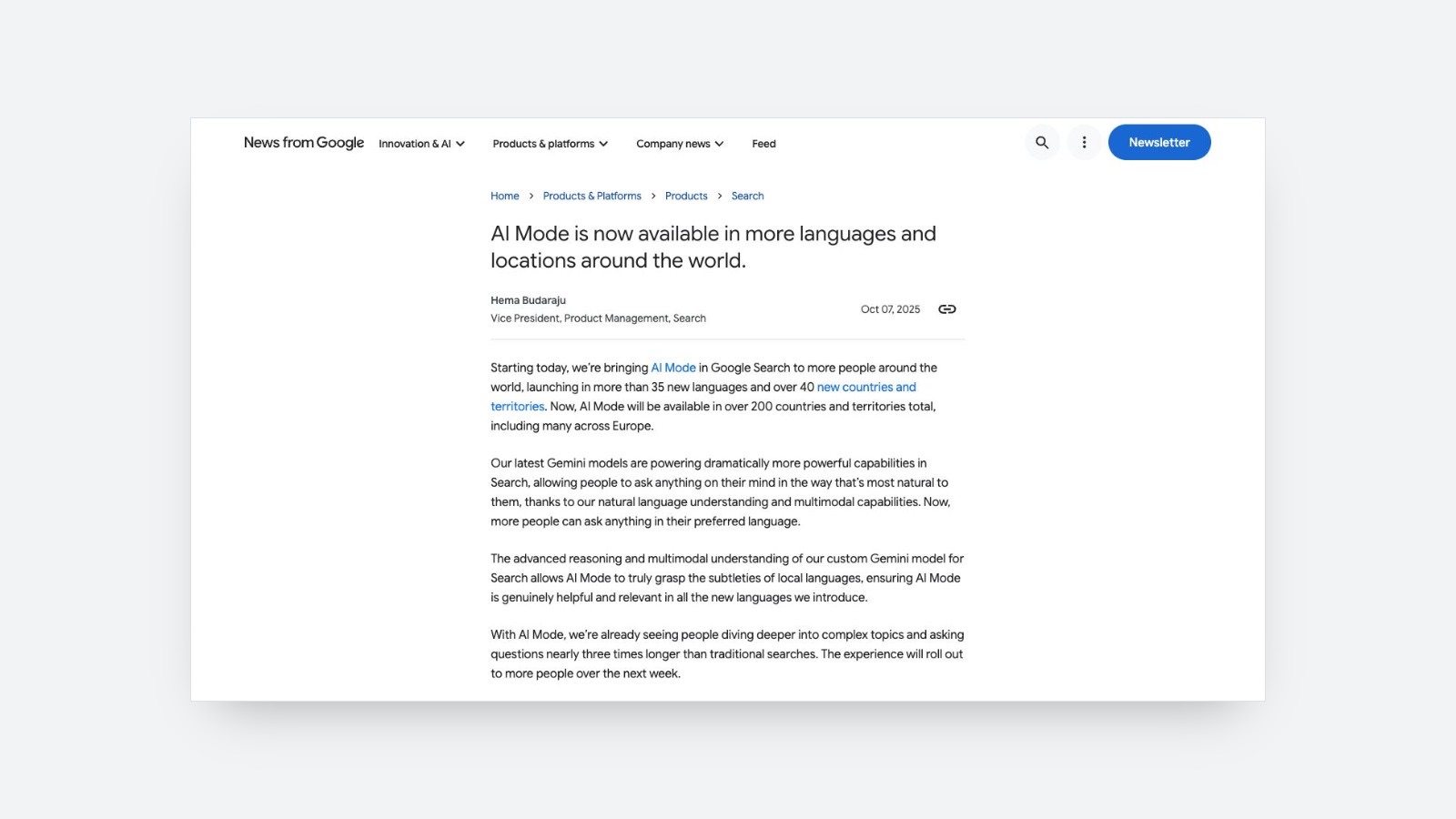
Google says existing Search, Shopping and Performance Max campaigns can serve in AI Overviews and AI Mode without separate campaigns or budgets.[1] Google announced AI Mode ads in 10 additional countries—Australia, Canada, India, Kenya, Malaysia, New Zealand, Nigeria, Pakistan, the Philippines and Singapore—on 28 October 2026.[19]
OpenAI’s model is more explicitly separated as an advertising product: it provides Ads Manager, partner access and a local reseller route.[3] Google’s cited materials describe rollout and campaign eligibility, but do not provide comparable advertiser ROI evidence.[13][10]
The operational choice is therefore straightforward:
- Use OpenAI’s route when direct ChatGPT campaign controls, ChatGPT-specific measurement or local Aleph support are priorities.[3]
- Use existing Google campaign infrastructure when an advertiser wants AI-surface eligibility through Search, Shopping or Performance Max campaigns.[1]
- Do not infer that one platform produces better returns solely from rollout coverage or buying mechanics.[10]
Frequently asked questions
Where can advertisers buy ChatGPT ads in November 2026?
Advertisers can buy ChatGPT Ads through OpenAI Ads Manager, existing agency and technology partners, or Aleph’s local sales operation in 44 markets.[3] Ads Manager eligibility requires the advertiser’s legal entity and billing location to be in one of OpenAI’s 89 listed countries and territories.[5][3]
How many countries have ChatGPT Ads?
OpenAI lists 89 countries and territories for Ads Manager availability as of November 2026.[2][1] That figure describes the listed availability footprint, while Aleph’s 44 markets describe local sales, contracting and billing coverage rather than 44 additional audience markets.[3]
How much does ChatGPT advertising cost?
OpenAI does not publish a standard platform-wide CPM, CPC or CPA in the cited material.[14] Its Help Center recommends a starting maximum CPC bid of $3–$5, while Brafton reported a $5.80 average CPC in one campaign; neither figure is a universal ChatGPT Ads price.[11]
Does ChatGPT Ads Manager have Target CPA and Target CPC?
Yes. OpenAI began moving new campaigns toward Target CPA and Target CPC average-cost goals on 9 November 2026.[12] These targets are not fixed prices or guaranteed maximums because auction outcomes can produce actual average costs above or below the target.[12]
What results are early ChatGPT advertisers reporting?
Early results vary by advertiser and measurement method. OpenAI reported positive directional results for Evernote, WeightWatchers and Dose, while Brafton reported $5.80 average CPC and one attributed conversion in a small campaign; Business Insider also reported mixed findings from a working paper and an Adthena survey.[13][17]
Sources
- 1About ads in AI-powered experiences in Google Search - Google Ads Help — support.google.com
- 2ChatGPT Ads expands to 26 new countries as over 100,000 advertisers have used the platform | OpenAI — openai.com
- 3ChatGPT Ads increases its market presence in 44 countries | OpenAI — openai.com
- 4New ways to buy ChatGPT ads | OpenAI — openai.com
- 5Ads Manager Availability | OpenAI Help Center — help.openai.com
- 6How we built ChatGPT’s novel ad stack for user trust and relevance | OpenAI — openai.com
- 7Ads that Talk Back: Implications and Perceptions of Injecting Personalized Advertising into LLM Chatbots — rtcl.eecs.umich.edu
- 8Ads in ChatGPT: The Basics | OpenAI Help Center — help.openai.com
- 9Building advertising for the way people use AI | OpenAI — openai.com
- 10ChatGPT Ads adds Target CPA and CPC bidding, expands product campaign controls — searchengineland.com
- 11International ChatGPT Ads results: CTR, CPC, conversions | PPC ONE — ppcone.cz
- 12Bidding strategies and how pricing works in ChatGPT Ads | OpenAI Help Center — help.openai.com
- 13ChatGPT Ads: What We Learned Spending $1,524 on OpenAI's Ad Platform | Brafton — brafton.com
- 14Reporting – Ads | OpenAI Developers — developers.openai.com
- 15More ways to measure ChatGPT Ads | OpenAI Ads — ads.openai.com
- 16Evernote turns AI-driven discovery into paid subscriptions | OpenAI — openai.com
- 17OpenAI's ChatGPT Ads Face ROI Test As Marketers Weigh Results - Business Insider — businessinsider.com
- 18New ad formats built with Gemini coming to Google Search — blog.google
- 19Ads in AI Mode expand to 10 new countries — blog.google
This report was compiled from the primary sources listed above. Read our editorial standards. To report an error, write to editorial@aisearchtimes.com.